Leadership Mission Statement and Philosophy
Home
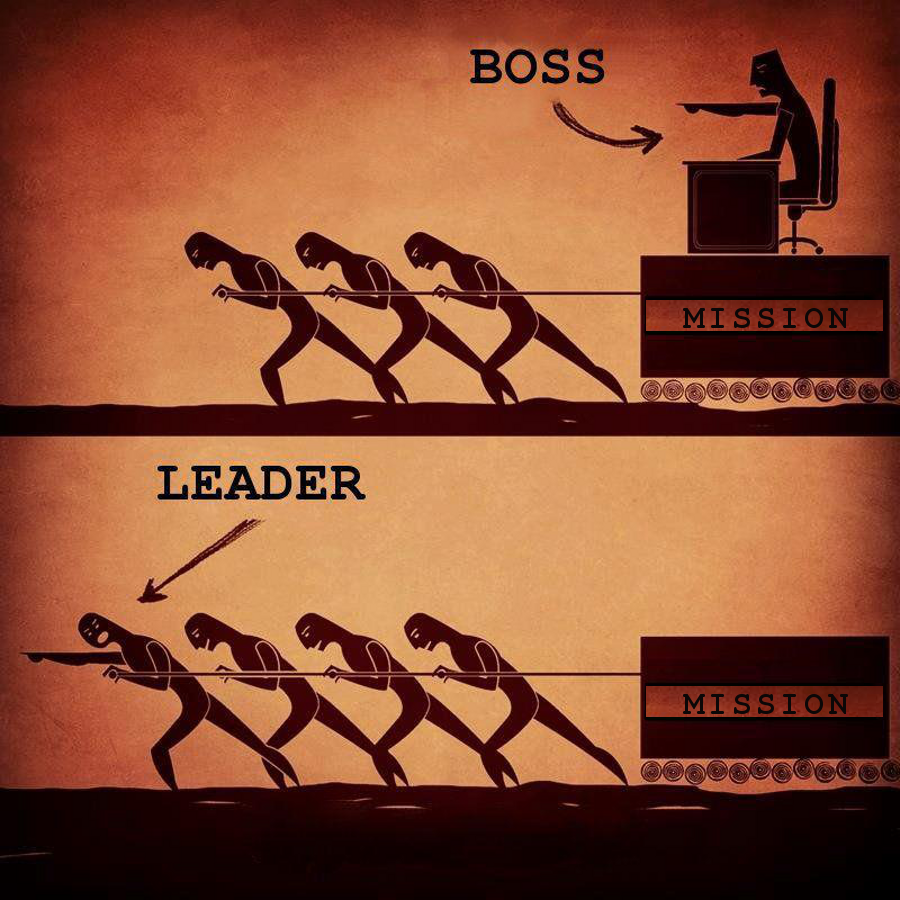
Image source: https://modernservantleader.com/servant-leadership/bad-boss-vs-good-leader-image/
Leadership, to me, is the ability to align people toward a common goal while actively developing their skills and capabilities, ultimately strengthening the effectiveness of the entire team (& and 1b). It is not the same as management, which is more robotic. As opposed to simply organizing stuff and making sure tasks get completed, leadership is more about the people. A leader needs to actually understand their peers, work alongside them, and know how to keep them motivated. (1a).
Leaders play a very important role. In my opinion, the most important role that a leader plays is helping their followers improve their skill sets while still getting things done (+). When people get stuck or don’t know how to approach something, it’s important to guide them through it, instead of just giving them the answer so they actually learn from it.
In my opinion, an ideal leader is empathetic toward their followers and is an excellent communicator (=). An ideal leader should also have both positional and personal power. For example, Take leading a team of engineers, a leader should have a position that one could only get from having a lot of experience, and they should be perceived as competent and knowledgeable by their followers.
An ethical leader is one that is true to their morals. It is not necessarily about the values or morals a leader holds, but more about acting based on those values and morals consistently. The choices that a leader makes and how a leader responds should be based on their ethical and moral code (1). My highest values on the Human Values Scale were hedonism, which was 2 standard deviation outside of the average, self-direction, which was also 2 standard deviation outside of the average, and achievement, which was 1 standard deviation outside of the mean. Hedonism was my highest score, which may seem bad at first, but I think it is because I value actually enjoying what I do. Self-direction as a value means I enjoy making decisions for myself, and achievement means that I care about doing well and proving that I am a capable person. Because of these values, I judge leaders based on whether they are genuine, independent, and working toward something. I respect leaders who can think for themselves and enjoy their work. At the same time, I do not respect leaders who are focused only on control and status (4a).
I personally want to be a leader because I like being able to help people figure things out when they are stuck (2). In engineering, a lot of the problems you deal with do not have obvious answers, and I want to be the kind of person people can come to when they are trying to figure out how to approach something. I also do not like when a group feels disorganized or when people are struggling and no one steps in. Being a leader gives me a chance to nudge them in the right direction, offer valuable insight, and keep the group motivated.
When I do become a leader, I want to be known as the kind of leader who is level-headed, easy to work with, and task-oriented (3). Because of my Human Values scale scores, my team members may judge my leadership as being very independent and goal-focused. My values give some clues about why that may be the case. My highest values were hedonism, self-direction, and achievement. Hedonism means I want to enjoy what I am doing and not just be miserable while working. Self-direction means I like being able to think for myself and make my own decisions, and achievement means I care about doing well and proving I am capable. Because of that, people may see me as motivated and driven, but they could also see me as selfish or too focused on the task if I am not careful. I need to make sure that while I am pushing to get things done, I am still listening to people and making sure they feel valued too (6a).
My biggest fear of being a leader is getting overwhelmed, not thinking things through, missing details, or not being patient with my team. I find that these things can happen when I am put under pressure. To deal with this, I need to be more mindful and present. When I can remember to stop and take a second, think methodically, and think things through, I can focus on the task at hand a lot better. I get distracted really easily, and when that happens, I may forget what kind of leader I want to be or why I want to be a leader in the first place. Keeping my composure and being patient is key.
Back Home